
Innov Clin Neurosci. 2026;23(7–9):32–33.
Özlem Totuk, MD, and Sevki Sahin, MD
Dr. Totuk is with Sancaktepe Şehit Prof. Dr. Ilhan Varank Training and Research Hospital, Istanbul, Turkey. Dr. Sahin is with University of Health Sciences, Hamidiye Faculty of Medicine, Department of Neurology, Istanbul, Turkey.
FUNDING: No funding was provided for this article.
DISCLOSURES: The authors have no relevant conflicts of interest.
Abstract: OBJECTIVE: To report an adult-onset phenotype of KIF1A-associated neurological disorder (KAND) associated with a novel heterozygous missense variant (c.2494C>T; p.Pro832Ser) located outside the kinesin motor domain. CASE PRESENTATION: We describe a 50-year-old woman with a 15-year history of progressive imbalance. Neurological examination revealed cerebellar dysarthria, truncal ataxia, bilateral dysmetria, and sensorimotor polyneuropathy. Brain magnetic resonance imaging demonstrated moderate cerebellar atrophy. Whole-exome sequencing identified a heterozygous KIF1A variant (c.2494C>T; p.Pro832Ser). No other pathogenic mutations were found. RESULTS: The variant was classified as a variant of uncertain significance, yet the patient’s clinical presentation was consistent with features of KAND. Compared with previously described early-onset KAND cases, our patient exhibited a milder, slowly progressive phenotype without seizures or cognitive impairment. The variant’s location outside the motor domain may correlate with this attenuated disease course. CONCLUSION: This case expands the phenotypic and genotypic spectrum of KAND and suggests that the novel KIF1A p.Pro832Ser variant may contribute to adult-onset cerebellar ataxia and axonal neuropathy. To our knowledge, this variant is not listed in ClinVar or population databases such as gnomAD or ExAC. Keywords: KIF1A, cerebellar ataxia, polyneuropathy, whole-exome sequencing, KAND, variant of uncertain significance
Introduction
Mutations in the kinesin family member 1A (KIF1A) gene, which encodes a microtubule-based motor protein, are associated with a broad spectrum of neurological disorders with autosomal dominant, recessive, or de novo inheritance patterns.1 KIF1A plays a crucial role in synaptic vesicle transport, axonal trafficking, and sensory neuron survival.2,3 Disruption of axonal transport between the neuronal soma, axon, and dendrites has been implicated in various neurodegenerative disorders.4
KIF1A-associated neurological disorder (KAND) presents a highly heterogeneous clinical spectrum, including developmental delay, cerebellar atrophy, optic atrophy, spastic paraplegia, peripheral neuropathy, microcephaly, ataxia, intention tremor, ptosis, facial diplegia, strabismus, nystagmus, hyperreflexia, and spasticity.3,5 Some patients may also exhibit autonomic dysfunction (eg, neurogenic bladder, constipation, impaired thermoregulation), and more rarely, endocrine abnormalities such as growth hormone deficiency and edema.5 On clinical examination, cerebellar signs, hyperreflexia, and spasticity are frequently reported.6 Disease severity often correlates with the type and location of the genetic variant.
Case Presentation
A 50-year-old woman presented with a 15-year history of progressive balance disturbance. Her medical history included hypothyroidism and restless leg syndrome. She was born to consanguineous parents (first cousins), and her father died at 56 years of age with a diagnosis of dementia.
Neurological examination revealed cerebellar dysarthria, decreased deep tendon reflexes in the lower limbs, bilateral dysmetria, dysdiadochokinesia, truncal ataxia, and gait ataxia necessitating assistance.
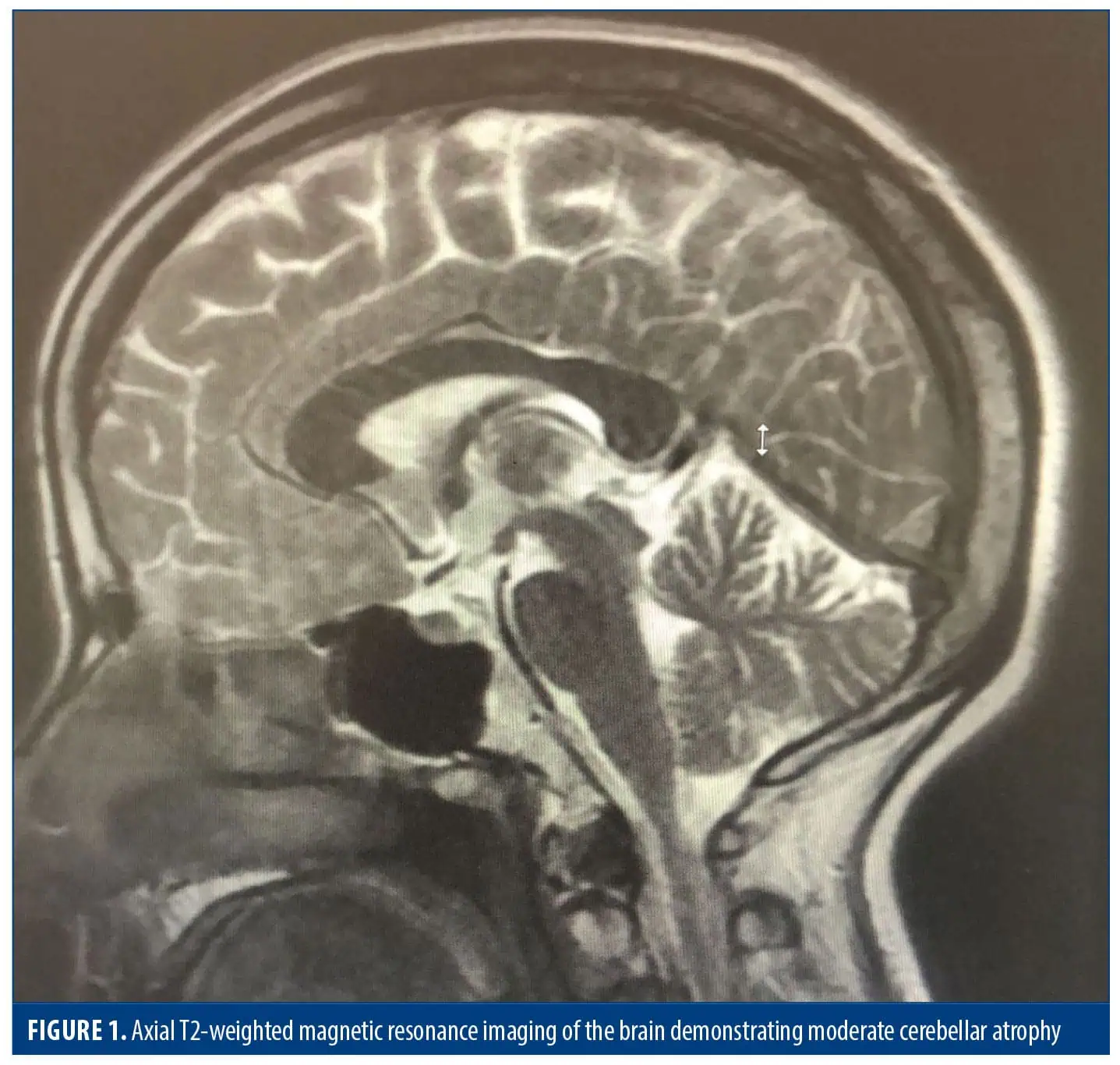
Brain magnetic resonance imaging (MRI) demonstrated moderate cerebellar atrophy (Figure 1). Electromyography showed sensorimotor axonal polyneuropathy, more prominent in the lower extremities. The patient reported a subjective improvement of approximately 20% after treatment with oral piracetam at a dose of 2,400 mg/day.
Genetic testing for cerebrotendinous xanthomatosis and spinocerebellar ataxia (SCA) panels was negative. However, whole-exome sequencing (WES) identified a heterozygous missense variant in KIF1A: c.2494C>T (p.Pro832Ser).
Discussion
Clinically, our patient’s presentation—characterized by progressive cerebellar ataxia and peripheral neuropathy—is consistent with the known phenotypic spectrum of KAND. Cheon et al7 described a p.T258M mutation linked to early-onset disease featuring intellectual disability, epilepsy, and optic atrophy. In contrast, our patient exhibited adult-onset symptoms with preserved cognitive function and no history of epilepsy, suggesting that the location of the variant outside the kinesin motor domain may contribute to a milder phenotype. Similarly, Morikawa et al8 have reported that variants outside the motor domain can be associated with less severe clinical features.
In relation to our case, Hama et al9 described a KIF1A mutation within the motor domain in a patient presenting with early-onset cerebellar ataxia, epilepsy, and intellectual disability. Supporting evidence for the pathogenicity of rare KIF1A variants has been demonstrated in functional models. For instance, Guo et al10 reported that the p.Ala397Asp missense mutation enhanced excitatory synaptic transmission and induced seizure-like activity in zebrafish, suggesting that even noncanonical variants may disrupt neuronal function. In contrast, our patient showed no seizure activity and maintained intact cognitive performance, further supporting a correlation between nonmotor domain variants and attenuated phenotypes.
The p.Pro832Ser variant identified in our patient is currently classified as a variant of uncertain significance (VUS) in the Franklin by Genoox database. It is not recorded in ClinVar or in major population databases, including gnomAD. According to VarSome, this variant fulfills ACMG criteria PM2 (absent from population databases) and PP3 (pathogenic predictions by in silico tools), though it lacks strong supporting evidence such as functional studies or familial segregation data.
Despite its current classification as a VUS, several findings support its potential clinical relevance: 1) the patient’s phenotype aligns with KAND; 2) common genetic causes have been excluded; and 3) previous studies suggest that nonmotor domain KIF1A variants can be disease-causing. Functional validation studies, including protein modeling, evolutionary conservation testing, and segregation analysis, will be crucial to clarify the pathogenicity of this variant.
A multicenter study by Della Vecchia et al11 showed that monoallelic KIF1A variants can lead to a wide clinical spectrum, including adult-onset spasticity and cerebellar ataxia. Their findings support the possibility that variants outside the motor domain may still contribute to KAND, consistent with our case.
Moreover, Mabondzo et al12 demonstrated a potential association between KIF1A and cognitive function in a mouse model of creatine transporter deficiency. Although our patient did not display cognitive impairment, her father’s history of dementia could suggest an extended phenotypic spectrum or underlying genetic predisposition, underscoring the importance of detailed family history.
Conclusion
In conclusion, this case describes a novel and rare KIF1A variant—p.Pro832Ser—as a plausible contributor to adult-onset cerebellar ataxia and axonal neuropathy. The findings support the hypothesis that nonmotor domain variants may be associated with milder, late-onset KAND phenotypes. Reporting such cases expands our understanding of the clinical and genetic diversity of KAND and underscores the importance of considering genetic evaluation in adult-onset neurodegenerative disorders of uncertain etiology.
References
- Roda RH, Schindler AB, Blackstone C. Multigeneration family with dominant SPG30 hereditary spastic paraplegia. Ann Clin Transl Neurol. 2017;4(11):821–824.
- Montenegro-Garreaud X, Hansen AW, Khayat MM, et al. Phenotypic expansion in KIF1A-related dominant disorders: a description of novel variants and review of published cases. Hum Mutat. 2020;41(12):2094–2104.
- Nair A, Greeny A, Rajendran R, et al. KIF1A-associated neurological disorder: an overview of a rare mutational disease. Pharmaceuticals (Basel). 2023;16(2):147.
- Aguilera C, Hümmer S, Masanas M, et al. The novel KIF1A missense variant (R169T) strongly reduces microtubule stimulated ATPase activity and is associated with NESCAV syndrome. Front Neurosci. 2021;15:618098.
- Boyle L, Rao L, Kaur S, et al. Genotype and defects in microtubule-based motility correlate with clinical severity in KIF1A-associated neurological disorder. HGG Adv. 2021;2(2):100026.
- Pennings M, Schouten MI, van Gaalen J, et al. KIF1A variants are a frequent cause of autosomal dominant hereditary spastic paraplegia. Eur J Hum Genet. 2020;28(1):40–49.
- Cheon CK, Lim SH, Kim YM, et al. Autosomal dominant transmission of complicated hereditary spastic paraplegia due to a dominant negative mutation of KIF1A, SPG30 gene. Sci Rep. 2017;7(1):12527.
- Morikawa M, Jerath NU, Ogawa T, et al. A neuropathy-associated kinesin KIF1A mutation hyper-stabilizes the motor-neck interaction during the ATPase cycle. EMBO J. 2022;41(5):e108899.
- Hama Y, Date H, Fujimoto A, et al. A novel de novo KIF1A mutation in a patient with ataxia, intellectual disability and mild foot deformity. Cerebellum. 2023;22(6):1308–1311.
- Guo Y, Chen Y, Yang M, et al. A rare KIF1A missense mutation enhances synaptic function and increases seizure activity. Front Genet. 2020;11:61.
- Della Vecchia S, Tessa A, Dosi C, et al. Monoallelic KIF1A-related disorders: a multicenter cross-sectional study and systematic literature review. J Neurol. 2022;269(1):437–450.
- Mabondzo A, Harati R, Broca-Brisson L, et al. Dodecyl creatine ester improves cognitive function and identifies key protein drivers including KIF1A and PLCB1 in a mouse model of creatine transporter deficiency. Front Mol Neurosci. 2023;16:1118707.